
Limited Company vs. Unlimited Company: 5 Things Hong Kong Entrepreneurs Should Know Before Starting a Business

Thinking of starting a business in Hong Kong? One of the first questions you’ll probably face is:
Should I set up a limited company, or run the business as an unlimited company?
Many new business owners look at the setup cost first and think an unlimited company seems cheaper and easier. That can be true in some cases. But if you plan to run the business long term, apply for funding, hire staff, sign a lease, or work with larger clients, your business structure matters more than just the initial cost.
It affects your legal responsibility, tax treatment, audit requirements, funding options, and how your business is seen by banks, partners, and clients.
In this guide, we’ll break down the key differences in a simple way, so you can get a clearer idea of which structure may fit your current business stage.
Key Takeaways
A limited company is a separate legal entity. In most cases, shareholders’ liability is limited to their capital contribution.
An unlimited company is usually simpler to set up, but the owner or partners may be personally liable for business debts.
A limited company is usually better suited for businesses with long-term growth plans, funding needs, or higher business risks.
An unlimited company may work for smaller, lower-risk businesses or early-stage market testing.
Don’t choose based on tax rates alone. You should also consider audit, compliance, funding, credibility, and personal risk.
What is the main difference between a limited company and an unlimited company?
A limited company is a separate legal entity. This means the company and its shareholders are legally separate. In most cases, if the company has debts, shareholders are only responsible up to the amount they have invested in the company. Their personal assets are generally better protected.
An unlimited company is usually operated as a sole proprietorship or partnership. It is simpler to set up and usually cheaper to maintain. However, the owner or partners have unlimited liability. If the business owes money, their personal assets may be used to settle business debts.
Put simply:
Comparison | Limited Company | Unlimited Company |
Legal status | Separate legal entity | Usually not a separate legal entity |
Personal liability | Generally limited to capital contribution | Owner / partners have unlimited liability |
Setup and maintenance cost | Usually higher | Usually lower |
Audit requirement | Usually requires audit | Usually simpler |
Funding and credibility | Usually stronger | Usually weaker |
Best suited for | Long-term business, higher risk, funding needs | Small, lower-risk, testing-stage business |
1. Legal liability: Do you want to separate personal assets from business risk?
This is one of the biggest differences.
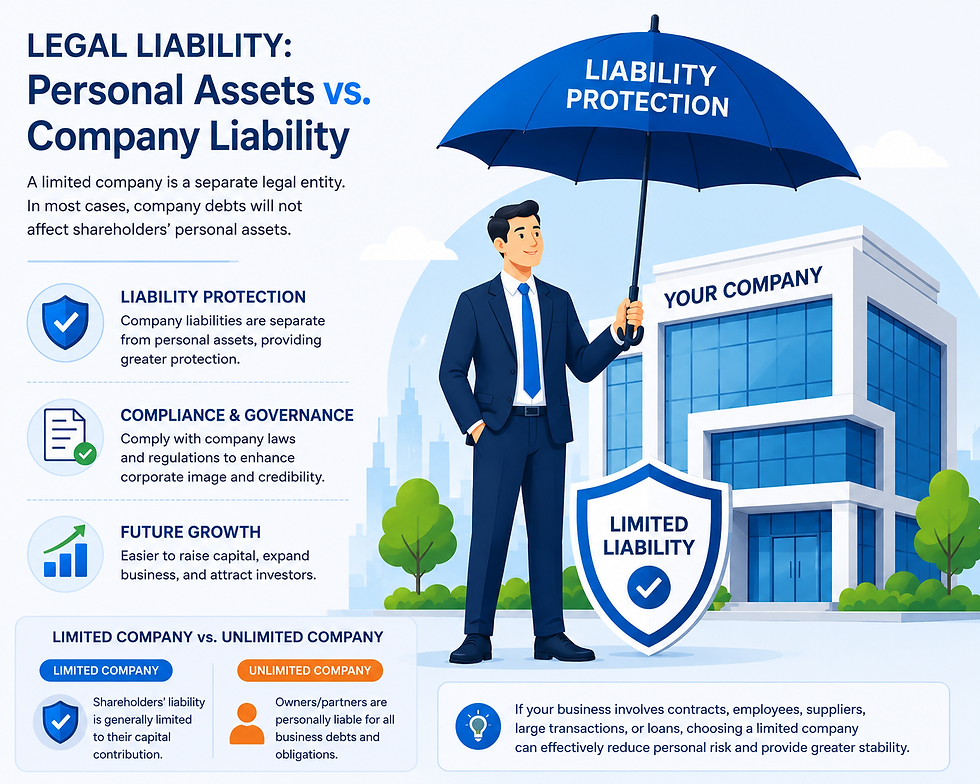
If you run a limited company, the company itself is a separate legal entity. In most cases, even if the company has debt problems, shareholders do not need to use their personal assets to repay company debts.
That said, there are exceptions. If there is a personal guarantee, fraud, illegal activity, or other special circumstances, directors or shareholders may still be held responsible.
An unlimited company works differently. The owner or partners carry unlimited liability. If the business cannot repay its debts, creditors may be able to pursue the owner’s personal assets.
So if your business involves leases, employees, suppliers, large transactions, or borrowing money, a limited company is often the safer structure.
2. Tax: Don’t just look at the headline rate
Hong Kong uses a two-tiered profits tax system.
For a limited company, the first HKD 2 million of assessable profits is generally taxed at 8.25%, and profits above that are taxed at 16.5%.
For an unlimited company, such as a sole proprietorship or partnership, the first HKD 2 million of assessable profits is generally taxed at 7.5%, and profits above that are taxed at 15%.
So it is not accurate to simply say that an unlimited company always has a higher tax rate. In many cases, the bigger differences are not just tax rates, but legal liability, audit requirements, compliance costs, funding options, and business credibility.
In other words, choosing a business structure should not be based on tax rates alone. You need to look at the whole picture.

3. Audit and compliance: A limited company costs more, but gives you cleaner records
A limited company usually needs to prepare financial statements and have them audited by a certified public accountant. This means higher annual maintenance costs.
But there is also an upside: your business records are usually more complete and easier to review.
If you want to apply for a business loan, bring in investors, work with larger clients, or scale the business over time, clear financial records can help build trust.
An unlimited company usually has simpler administrative requirements. This can be suitable for a small business with fewer transactions and lower risk. However, if the business grows later, messy or incomplete records may make it harder to apply for funding or move into a more formal structure.
4. Funding and credibility: A limited company usually looks more established
If you may apply for an SME loan, bring in investors, or work with larger companies in the future, a limited company usually has an advantage.
That’s because it has a clearer company structure, shareholder arrangement, financial statements, and audit records. Banks, investors, and business partners can more easily assess the company’s position.
An unlimited company can still be flexible and useful at the early stage. For example, it may work well if you are simply testing a small, low-risk business idea. But if your goal is to build a long-term business, a limited company often gives you a stronger foundation.
5. Who should consider a limited company, and who should consider an unlimited company?
A limited company may be more suitable if you:
Plan to run the business long term
Have higher legal or financial risks
Need to sign a lease, hire staff, or work with suppliers
May apply for funding or bring in investors
Want to build a more formal business image
Want to separate personal assets from company liabilities
Startups, consulting firms, trading companies, e-commerce businesses, and businesses with funding plans often choose a limited company for these reasons.
An unlimited company may be more suitable if you:
Offer freelance or personal services
Run a small local business
Are still testing the market
Have relatively small transaction amounts
Do not need funding or expansion yet
Want to start with lower costs
The main thing to remember is personal liability. Don’t choose an unlimited company only because it is cheaper at the beginning. The legal and debt risks may become more important later.
Frequently Asked Questions
Do freelancers need to set up a limited company?
Not always. If you only take on a small amount of freelance work, the risk is low, and your income is still unstable, operating under your own name or as an unlimited business may be enough.
But if you start working with corporate clients, signing contracts, earning more stable income, or building a formal brand, a limited company may be worth considering.
Should an online shop use a limited company or an unlimited company?
If your online shop is still at the testing stage and the transaction size is small, a simpler structure may be enough.
But if you plan to hold inventory, hire staff, rent storage space, run paid ads, or handle a large number of customer orders, a limited company is usually more suitable.
Can an unlimited company be changed into a limited company later?
Yes, but it is usually not a simple “name change”. In practice, you may need to set up a new limited company and then handle the transfer of business assets, contracts, bank accounts, and other arrangements.
That’s why it is better to think about your direction for the next one to three years before deciding.
Does a limited company with no income still need to file tax returns or prepare accounts?
In general, even if a company has no income, it may still have tax filing and compliance obligations. The actual requirements depend on the company’s status, the documents issued by the Inland Revenue Department, and whether the company has carried out any business activities.
If your company has been set up but is not yet operating, it is still worth checking what records and documents you need to keep.
Final Thoughts: It’s not about which one is “better”, but which one fits you
There is no one-size-fits-all answer.
A limited company is usually better for entrepreneurs who want to build a long-term business, reduce personal risk, improve credibility, or apply for funding.
An unlimited company may be enough if you are starting small, testing an idea, and keeping risk and costs low.
Before choosing a structure, take a step back and look at your business model, income sources, funding needs, risk level, and future plans. The right structure should support where your business is going, not just where it is today.
Everpro can help entrepreneurs review their business structure from the perspective of legal liability, tax, funding, and long-term planning, so you can make a clearer decision before taking the next step.



Comments